
Your first job interview can feel like a catch-22: employers want experience, but you need a job to gain it. When an interviewer asks, “Tell me about a time you handled a difficult situation,” it is easy to worry that your lack of professional experience puts you at a disadvantage.
But having no full-time work history does not mean you have nothing valuable to offer. Academic projects, internships, extracurricular activities and volunteer work can all demonstrate skills employers look for. The key is learning how to connect those experiences to the role you want.
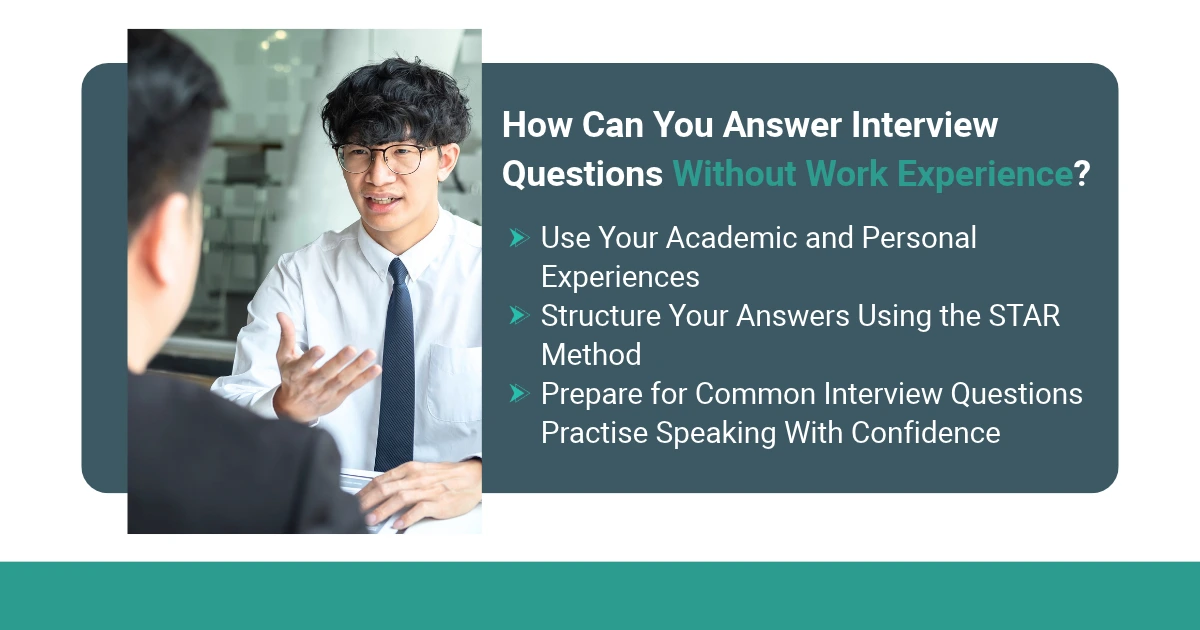
How Can You Answer Interview Questions Without Work Experience?
1. Use Your Academic and Personal Experiences
Think beyond previous jobs. A university group project might demonstrate teamwork, while organising an event could show leadership, planning and problem-solving. Choose examples where you made a meaningful contribution rather than simply describing what the group achieved.
For example, if asked about managing a deadline, explain how you organised a project, divided responsibilities and helped your team complete its work on time. Be honest about your role and focus on what you learned.
2. Structure Your Answers Using the STAR Method
Behavioral interview questions often ask how you handled a particular situation. The STAR method helps you answer clearly:
- Situation: Explain the context.
- Task: Describe your responsibility.
- Action: Explain what you personally did.
- Result: Share the outcome and what you learned.
You do not need an impressive corporate achievement to use this method. A challenging assignment or student society responsibility can provide a relevant example when explained thoughtfully.
3. Prepare for Common Interview Questions
Questions such as “Tell me about yourself,” “What are your strengths?” and “Why should we hire you?” are opportunities to show your motivation and potential.
Instead of apologising for your lack of experience, explain what you have studied, which skills you have developed and why the position interests you. Connect your strengths to the employer’s requirements, and support your claims with specific examples.
4. Practise Speaking With Confidence
Knowing what to say is only half the challenge. Nervousness, rushed answers and unclear explanations can make it difficult to communicate your strengths.
Practising aloud, recording your responses and participating in mock interviews can help you become more comfortable. If you are unsure where to start, Interview Equalizer training offers structured preparation tailored to your target role, including practice with behavioural, situational and technical questions.
How Can Interview Coaching Help Recent Graduates?
At Pro-Tax Executive Search, we understand that graduates may have the academic knowledge but lack experience navigating professional interviews. Our Interview Equalizer programme, led by Paul Yroz, draws on more than 30 years of experience in executive search and interview preparation.
Working with a job interview coach for graduates gives candidates an opportunity to practise realistic interview scenarios, receive constructive feedback and improve how they present their qualifications. Our professional interview coaching also addresses communication, body language and adapting responses to different interview formats.
Through our career coaching for new graduates, we help candidates identify transferable skills and communicate their potential more effectively. Our graduate training includes a live video session, personalised preparation based on the job description and mock interview questions relevant to the position.
Start Your Career With Greater Confidence
Your first interview does not have to be a test of experience you have not yet gained. With the right preparation, you can demonstrate your strengths, communicate your potential and approach employers with greater confidence.
At Pro-Tax Executive Search, we help graduates prepare for the transition from education to employment through our Interview Equalizer programme.
Ready to make a stronger first impression? Visit our Interview Equalizer for Graduates page to explore our training options and take the next step towards your career.